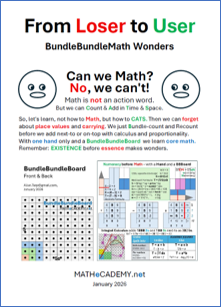
Can we Math? No, we can’t! Math is not an action word.
But we can Count & Add in Time & Space.
So, let’s learn, not how to Math, but how to CATS. Then we can forget about place values and carrying. We just Bundle-count and Recount before we add next-to or on-top with calculus and proportionality. With one hand only and a BundleBundleBoard we learn core math. Remember: EXISTENCE before essence makes wonders.
Contents
BundleBundleMath Wonder 01. Adding last numbers. 1
BundleBundleMath Wonder 02. Numbers as Pictures, Viking Numbers. 1
BundleBundleMath Wonder 03. Addition 2
BundleBundleMath Wonder 04. Subtraction. 2
BundleBundleMath Wonder 05. Multiplication. 2
BundleBundleMath Wonder 06. Long multiplication. 3
BundleBundleMath Wonder 07. Short division. 3
BundleBundleMath Wonder 08. Long division. 4
BundleBundleMath Wonder 09. Equations Solved: to Opposite Side with Opposite Sign 4
BundleBundleMath Wonder 10. Square Roots. 5
BundleBundleMath Wonder 11. Add and Subtract Squares. 5
BundleBundleMath Wonder 12. Finding the Square Root of a number. 6
BundleBundleMath Wonder 13. Squaring Rectangles. 7
BundleBundleMath Wonder 14. Squaring Triangles. 7
BundleBundleMath Wonder 15. Squaring Circles. 8
BundleBundleMath Wonder 16. Squares in STEM and STeN 8
BundleBundleMath Wonder 17. Pouring Water with Quadratic equations. 9
BundleBundleMath Wonder 18. Multiplication tables on a BundleBundleBoard 10
BundleBundleMath Wonder 19. Adding on-top with proportional ReCounting. 11
BundleBundleMath Wonder 20. Adding next-to with Integral Calculus. 12
BundleBundleMath Wonder 21. ReCounting Goods gives PerNumbers and Fractions 12
BundleBundleMath Wonder 22. The ReCount Formula and per-numbers are the core of STEM and STeN 13
BundleBundleMath Wonder 23. Per-numbers add as Areas (Integral Calculus) 13
BundleBundleMath Wonder 24. Algebra ReUnites Unlike & Like Unit- & Per-numbers 14
Slides to the BundleBundleMath Wonders 15
Sample: BundleBundleMath Wonder 01. Adding last numbers.
A grade 3 child sat alone with the desk turned ninety degrees to the wall in the back of the class. Why are you here? I confuse the last numbers 7 and 8 and mostly add them wrong. Try 6 plus 8. OK, I start with 6 and say, 7 or eight, seven or eight, nine, ten, ten-one sorry eleven, thirteen, fourteen, fifteen, no wait I am not sure. Do you use number-sticks? No, we use snap cubes, here is a 6 row, and here an 8 row, so I place them after each other and start counting, but it is so long and after ten I become confused.
Can I show you what we did when I was a child? Yes. As eight we used two diamond signs from the cards, one below the other. Then we let a finger take a trip around the two while we counted the roads. 1, 2, 3, 4, break, 5, 6, 7, 8. In this way we saw that 8 contains two fours both on the cards and on our hands if we bend the thumbs. OK. And, when counting our fingers, sometimes we said ‘Hand and 1’ instead of six.
Let me try. 1, 2, 3, 4, 5, 1 Hand 1, 1 Hand 2, 1 Hand 3, 1 Hand 4, 1 Hand 5, or two Hands. Right, and two hands we called one Bundle if we count by bundling in tens: ten, twenty, thirty etc.
But then we don’t need the numbers between five and ten? No.
And, to add 6 to 8 we just add 1 Hand 1 to 1 Hand 3, which gives two Hands and 4, or ten and four, fourteen, or 1 Bundle 4, right? Right.
OK, so 1Hand1 plus 1Hand2 is 2Hand3; and 1Hand3 plus 1Hand4 is 2Hand7, so now I can also add the last numbers? Yes.
And when we use snap cubes, we can place the rows on top instead of after each other, so that we can see the two hands as a ten so only the small numbers are counted? Yes.
And we don’t even have to begin with five sticks, we just use a black cube for a hand; and when we write it, we can write 6 as 1H1? Yes, we can.
And the black cube could also mean ten or a bundle, so that 1B1 and 1B2 is 2B3, or 23; and so that 2B1 + 3B2 is 5B3 or 53? Yes.
In the break the child stayed at the desk and counted without using the names between five and ten. The class was curious and gathered around to see the child adding 6 to 8 by placing two cubes on-top of four cubes, which made the class protest “That is not 8 and 6 that is 4 and 2”. The child refused: “The black cube is a hand, so the four cubes are 1Hand3, and the two cubes are 1Hand1 that add as four and two hands that is ten, so fourteen, also called 1 Bundle 4 since we count by bundling in tens.”
In the next lesson they asked the teacher if also they could use hands when counting and adding, so the child was invited to take the front seat to instruct the teacher, staying there for the rest of the school year.
● Existence before essence makes wonders. As does numeracy before math.